Best SMM Panel & SMM Panel India: A Complete Guide for Resellers
Anyone who has spent time managing social media accounts for clients, running a reseller business, or trying to grow a brand's online presence has probably run into the same frustration: not every SMM panel does what it promises. Orders stall halfway through. Support goes quiet right when you need an answer. Pricing pages look simple until you actually place an order and realize the numbers don't add up the way you expected.
This is exactly why picking the right panel matters more than most people assume when they first start out. Agencies need consistency across dozens of client accounts. Freelancers need a tool they can rely on without constantly checking in. Resellers need margins that actually make sense and a dashboard that doesn't eat up their entire day. And businesses just want their social media spend to translate into something real, not vague promises.
Common problems people run into include poor service quality, delayed delivery, unclear pricing, weak customer support, unreliable providers, dashboards that feel like they were built a decade ago, and order management that makes it hard to track what's actually happening with your money. None of these are minor annoyances — they directly affect whether a panel is worth using at all.
This guide walks through what an SMM panel actually is, how it works, what separates a dependable provider from a risky one, and what resellers and Indian users specifically should look for before committing. The goal is to help you make an informed decision, not to convince you that one option is universally "the best."
What Is an SMM Panel?
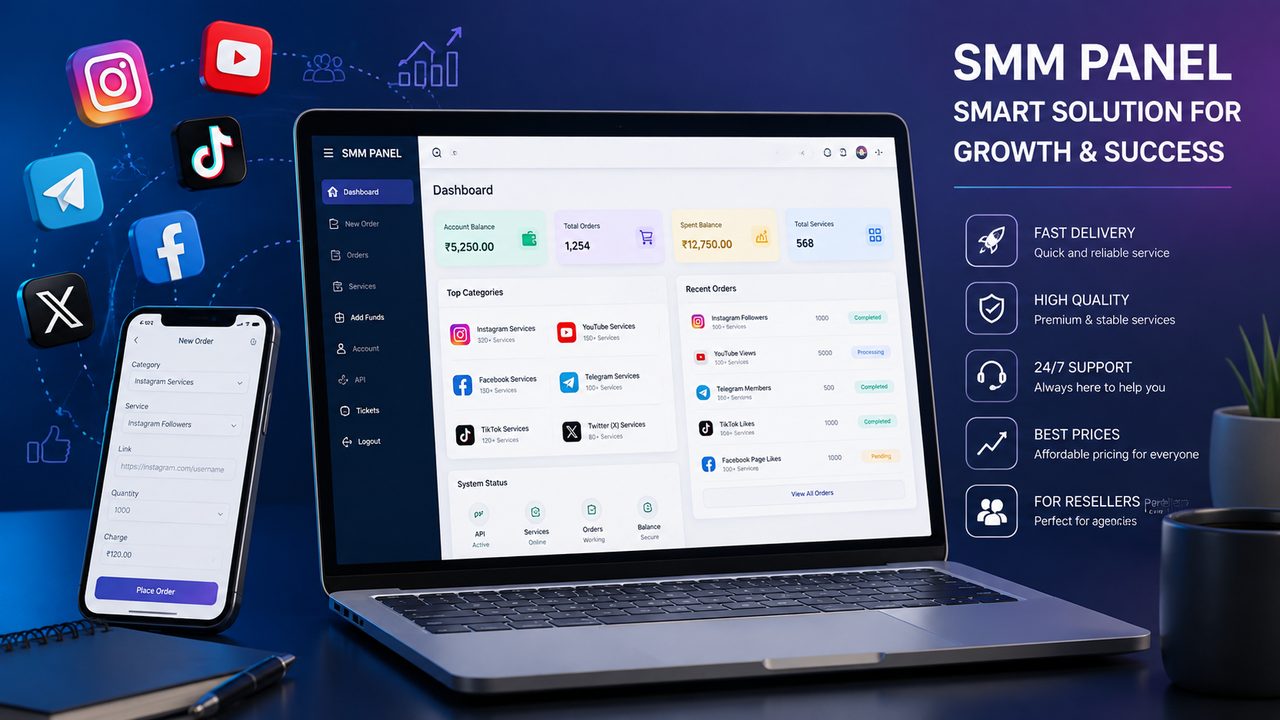
An SMM panel (Social Media Marketing panel) is an online platform where users can purchase social media services — things like likes, views, followers, comments, or shares — for platforms such as Instagram, YouTube, Facebook, and TikTok. Instead of manually managing multiple vendors or negotiating individual deals, users log into one dashboard, browse a list of available services, and place orders directly.
The purpose of an SMM panel is to simplify social media service delivery. Marketers, agencies, and resellers use these platforms to fulfill client requests quickly, without having to build their own infrastructure or negotiate with individual providers for every single service.
Here's generally how the user experience works. After creating an account, users add funds to their panel balance. From there, they browse a service list organized by platform and category, select what they need, and submit an order along with the relevant link or account detail. The dashboard then shows order status — pending, in progress, completed, or partial — so users can track exactly what's happening.
Most panels also offer an API, which allows developers, agencies, and resellers to integrate the panel's services directly into their own websites or automated systems. This is particularly relevant for anyone running a SmmPanel business themselves, since API access lets them resell services under their own branding without manually placing every order.
Pricing on these platforms is typically listed per 1,000 units (for example, per 1,000 views or per 1,000 followers), which makes it easier to compare providers at a glance — though, as we'll get into later, the lowest listed price isn't always the best value.
How Does an SMM Panel Work?
If you've never used one before, the process is more straightforward than it looks. Here's the typical step-by-step flow:
1. Create an account. Sign up with an email address, and in most cases you'll get access to the dashboard immediately.
2. Add funds. Panels usually support several payment methods, and your balance is used to pay for orders as you place them.
3. Select a service. Browse the service list — organized by platform (Instagram, YouTube, Facebook, TikTok) or by service type (followers, views, engagement, etc.).
4. Enter the required details. This usually means pasting a profile link, video URL, or post link, along with the quantity you want to order.
5. Submit the order. Once submitted, the order enters a queue and processing typically begins shortly after.
6. Track order progress. A good dashboard will show real-time status updates so you're not left guessing.
7. Check completion or status. Once finished, the order will show as completed, and any issues (partial delivery, cancellations) should be visible and explained.
For someone placing a single order, this process takes a few minutes. For agencies or resellers managing dozens of orders daily, the real value comes from how well the dashboard handles bulk actions, order history, and status visibility — which is a big part of what separates a good panel from a mediocre one.
What Makes the Best SMM Panel?
There's no single feature that makes a panel "the best" — it's a combination of factors that need to work together consistently. Here's what actually matters.
Service Quality
It's tempting to focus purely on price, but service quality should come first. A cheap service that delivers inconsistently or gets flagged by the platform's algorithm isn't actually saving you money — it's costing you in wasted spend and potential account issues. Quality means orders complete as described, without unusual drop-offs or irregular delivery patterns.
Competitive Pricing
Pricing matters, but transparency matters more. A panel that clearly lists what you're paying for — with no hidden fees or vague service descriptions — is easier to budget around and easier to trust, especially if you're reselling and need predictable margins.
Fast and Consistent Delivery
Delivery speed varies by service and platform, and it's worth being realistic here: not every order completes instantly, and that's normal. What matters is consistency — if a panel says a service takes a certain amount of time, it should generally match that estimate order after order.
Service Variety
Since most agencies and resellers work across multiple platforms, a panel that supports Instagram, YouTube, Facebook, TikTok, and others under one dashboard saves a significant amount of time compared to juggling separate providers for each network.
Easy Dashboard
A cluttered or confusing dashboard slows everything down, especially for anyone placing bulk orders. Clear categorization, simple search, and visible order history all make a real difference in day-to-day usability.
Customer Support
Things go wrong sometimes — an order stalls, a link was entered incorrectly, or a service description wasn't clear. Responsive support (even just quick, clear answers) is often the difference between a minor hiccup and a lost client.
Order Tracking
Being able to see order status, history, and any partial completions in real time gives users confidence that they know exactly what they're paying for and where their money went.
API Support
For resellers and agencies, API access is often non-negotiable. It allows orders to be placed programmatically, service catalogs to sync automatically, and entire reseller storefronts to run without manual intervention.
Reliability
Ultimately, reliability ties everything together — consistent uptime, accurate service descriptions, and a track record of orders completing as expected. This is usually something you can only judge after testing a panel yourself, which is why starting small is a smart approach (more on that below).
Best SMM Panel for Resellers
Resellers have different priorities than someone placing a one-off order. If you're building a business around reselling social media services, evaluating a panel properly before committing matters a lot more, since your own reputation is on the line with every order you fulfill for your clients.
Here's what to look at closely:
• Wholesale pricing — reseller rates should be meaningfully lower than retail, giving you room for a sustainable margin.
• Reseller margins — understand what markup is realistic for your market before setting your own pricing.
• API availability — needed if you want to automate order placement or build your own storefront.
• Service stability — services that disappear or change without notice make it hard to run a dependable business.
• Order automation — bulk order tools and API integration save enormous amounts of time as your order volume grows.
• Bulk ordering — check whether the platform handles large volume orders smoothly, without manual bottlenecks.
• Service catalog — a broad, well-organized catalog makes it easier to serve different client needs from one place.
• Refill or replacement policies where applicable — worth understanding before you rely on a service for client work.
• Customer support — as a reseller, you need fast answers, since delays affect your own clients too.
• Order tracking — clear visibility into every order helps you manage client expectations accurately.
• Scalability — a panel that works fine at low volume might behave differently at scale, so it's worth testing gradually.
• Dashboard usability — since you'll be in it daily, a clean and efficient interface saves real time.
It's worth being upfront here: reselling social media services can be a legitimate business model, but it's not a guaranteed income stream, and results depend heavily on your own pricing, service quality, and client relationships. Anyone evaluating this path should treat it like any other business — with realistic expectations rather than assumptions of easy profit.
For resellers specifically comparing providers, it helps to review a dedicated breakdown of what to check before choosing a Best SMM Panel, since reseller needs differ quite a bit from casual, one-time use.
SMM Panel India — What Should Indian Users Look For?
Indian users — whether marketers, freelancers, small business owners, or resellers — often have a slightly different set of priorities compared to international users, mostly tied to payment convenience, support responsiveness, and local pricing expectations.
A few things worth checking specifically:
• INR-friendly pricing where available — panels that display pricing or accept payments in Indian Rupees remove a layer of friction compared to constantly converting currency.
• Payment convenience — support for commonly used Indian payment methods makes the process smoother.
• Customer support responsiveness — time zone alignment matters here, since delayed responses across time zones can slow down issue resolution.
• Service availability — not every panel supports the same range of platforms or regions equally well, so it's worth checking that the services you need are actually available.
• Pricing transparency — this applies everywhere, but is especially useful to double-check given how many providers target the Indian market with aggressive low-price advertising.
• Reseller requirements — Indian resellers should evaluate wholesale pricing and API access the same way any reseller would, factoring in local competition and pricing norms.
• Agency and freelancer use — many Indian digital marketing agencies and freelancers use these platforms to support client work, so ease of use and dependable delivery are especially important when managing multiple accounts.
• Local market considerations — understanding how a service performs for an Indian audience or Indian-based accounts can differ from global benchmarks, so testing before scaling up is a reasonable approach.
If you're specifically researching providers built with the Indian market in mind, it's worth reading a more detailed comparison on SMM Panel India options, since regional factors can meaningfully affect which provider makes sense for you.
Best SMM Panel vs Cheapest SMM Panel
It's easy to assume the cheapest option is automatically the smartest choice, but that's not always true in practice. Here's a balanced comparison of what tends to differ:
Factor Cheapest Panel Quality SMM Panel
Price Low Competitive
Service Quality Can vary More consistent
Support May be limited More accessible
Dashboard Basic or advanced User-friendly
Reliability Can vary More dependable
Reseller Features May vary Important focus
This doesn't mean cheap panels are automatically bad, or that expensive panels are automatically good — pricing alone isn't a reliable indicator of quality in either direction. The point is that price should be one factor among several, not the only one driving your decision. A slightly higher price paired with consistent delivery and responsive support is often a better long-term value than the lowest number on the page.
How to Choose an SMM Panel
Rather than guessing, it helps to work through a practical checklist before committing to any provider:
1. Identify your social media requirements — know which platforms and service types you actually need before browsing options.
2. Check available services — confirm the panel actually supports what you're looking for, not just the platforms it advertises broadly.
3. Compare pricing — look at a few providers side by side rather than committing to the first one you find.
4. Review service descriptions — vague descriptions are often a warning sign; clear, specific descriptions are a good indicator of a well-run platform.
5. Check support options — look for live chat, ticket systems, or other direct contact methods, and test response times if possible.
6. Evaluate dashboard usability — a free trial order or small test purchase can tell you a lot about how the interface actually functions.
7. Check reseller and API features — relevant if you plan to scale or automate your usage.
8. Understand order policies — refund, refill, or replacement policies (where offered) should be clearly stated, not buried or vague.
9. Start with a small test order — this is one of the most useful steps and is often skipped. A small order tells you far more than a services page ever will.
10. Evaluate performance before scaling — only increase order volume once you've confirmed consistent, reliable delivery.
This process takes a bit more time upfront, but it significantly reduces the risk of wasted spend or wasted client trust down the line.
SMM Panel for Agencies, Freelancers and Businesses
Different users approach SMM panels with different goals, so it's worth breaking down how each group typically benefits.
Agencies
Agencies managing multiple client accounts benefit most from centralized order management — being able to see all orders, across all clients, in one dashboard, rather than juggling separate tools or spreadsheets. Bulk ordering and API access become especially valuable once client volume grows.
Freelancers
Freelancers often use SMM panels to simplify service fulfillment when a client requests specific social media growth support. Instead of manually sourcing services from multiple places, a reliable panel lets a freelancer fulfill requests efficiently while focusing their actual time on strategy and client communication.
Resellers
As covered earlier, resellers rely on wholesale pricing, API integration, and order automation to run their own service business on top of an existing panel's infrastructure.
Small Businesses
Small businesses should approach SMM panels with a bit more caution. These platforms can be useful for specific, limited goals — supplementing visibility for a new page, for instance — but they shouldn't be treated as a replacement for a genuine content and engagement strategy. A business account with excellent numbers but no real engagement or content strategy behind it isn't actually building a sustainable audience.
It's worth being clear: an SMM panel is a tool, not a full marketing strategy. It works best as one component of a broader approach, not a shortcut that replaces the rest of the work.
Common Mistakes When Choosing an SMM Panel
A lot of frustration with SMM panels comes down to avoidable mistakes made early in the selection process:
• Choosing only based on price, without checking service quality or reliability first.
• Ignoring service descriptions, which often contain important details about delivery speed, expected behavior, or limitations.
• Not checking support options before placing an order, only to discover there's no way to get help when something goes wrong.
• Ordering large quantities without testing, which multiplies the risk if something doesn't go as expected.
• Ignoring refund or refill policies, leaving no recourse if an order underdelivers.
• Not checking API functionality for reseller needs, then discovering later that automation isn't well supported.
• Using unrealistic growth expectations, assuming an SMM panel alone will drive meaningful business outcomes.
• Ignoring platform policies, which can create account-level risks depending on the service and how it's used.
• Selecting a provider without evaluating reliability, based purely on marketing claims rather than actual testing.
Most of these mistakes are easy to avoid simply by slowing down and testing before scaling — a theme that comes up repeatedly throughout this guide for good reason.
How to Use an SMM Panel Effectively
Getting real value from an SMM panel comes down to treating it as a supporting tool, not the entire strategy. A few practical recommendations:
• Prioritize quality content. No amount of external service activity replaces content that actually resonates with an audience.
• Post consistently. Growth tools work better alongside a consistent posting schedule than as a replacement for one.
• Engage with your audience. Real replies, comments, and interactions build the kind of community that services alone can't create.
• Check analytics regularly. Understanding what's actually working helps you make better decisions about where to invest time and budget.
• Balance organic and paid efforts. Organic growth and paid campaigns each play a different role, and neither fully replaces the other.
• Build brand credibility over time. Sustainable growth is generally the result of consistent effort, not a single tactic.
• Test services before scaling. As mentioned earlier, small test orders reduce risk and help you understand what to expect.
It's worth being direct about this: no SMM panel can guarantee followers, engagement, reach, or sales. Anyone promising guaranteed outcomes isn't giving you an accurate picture of how these platforms actually work.
Is an SMM Panel Worth Using?
The honest answer is: it depends on how you use it. For agencies and resellers managing client work, a dependable panel can genuinely streamline operations and save significant time. For freelancers, it can simplify service delivery. For businesses experimenting with visibility on a new page or campaign, it can offer a limited, supplementary boost.
That said, results vary depending on the specific service, the platform involved, the state of the account being promoted, the campaign's overall objectives, the quality of the surrounding content, and the provider itself. An SMM panel isn't a universal solution, and it works best when paired with a genuine content and engagement strategy rather than used as a standalone fix.
If your goals involve long-term brand building, audience trust, or organic community growth, an SMM panel should be treated as one tool among several — not the core of your strategy.
Why Consider SMM Promax?
If you're evaluating providers after reading through all of the above, SMM Promax is one option worth looking into directly, based on the same criteria discussed throughout this guide.
Rather than making broad claims, it's more useful to look at what you can actually verify yourself: the range of services offered across different social platforms, how pricing is presented, whether the dashboard feels usable for your workflow, whether reseller and API functionality meet your needs, and how support is structured. These are the same factors this guide has walked through for evaluating any SmmPanel, and they apply just as much here.
The most practical approach, as covered in the "How to Choose an SMM Panel" section above, is to test with a small order first and judge the experience directly — dashboard usability, order tracking, delivery consistency, and support responsiveness — before deciding whether it fits your ongoing needs as an agency, freelancer, reseller, or business.
Frequently Asked Questions
What is an SMM panel?
An SMM panel is an online platform where users can purchase social media marketing services — such as followers, likes, views, and comments — for platforms like Instagram, YouTube, Facebook, and TikTok, typically through a dashboard that allows order placement and tracking.
How does an SMM panel work?
Users create an account, add funds, browse available services, submit an order with the relevant link or details, and then track the order's progress through the dashboard until it's completed.
What is the best SMM panel for resellers?
There's no single universal answer, since the right choice depends on your specific needs — but resellers should prioritize wholesale pricing, API access, service stability, and dependable order automation over price alone.
How do I choose the best SMM panel?
Start by identifying your service requirements, compare pricing and service descriptions across a few providers, check support responsiveness, and place a small test order before committing to larger volumes.
What is SMM Panel India?
It refers to SMM panels that are relevant to Indian users specifically, often through INR-friendly pricing, familiar payment methods, and support that aligns well with Indian time zones and market needs.
Are SMM panels useful for agencies?
Yes, agencies commonly use SMM panels to manage multiple client accounts and orders from a single dashboard, particularly when the panel supports bulk ordering and clear order tracking.
What should resellers check before choosing an SMM panel?
Resellers should evaluate wholesale pricing, API availability, service catalog breadth, order automation, dashboard usability, and support quality before committing to a provider.
Is the cheapest SMM panel always the best?
Not necessarily. Price is one factor, but service quality, reliability, and support often matter more for long-term satisfaction, especially for anyone reselling services to their own clients.
Does an SMM panel provide guaranteed results?
No reputable provider can guarantee specific outcomes like follower counts, engagement, or sales, since results depend on multiple factors including content quality, platform algorithms, and account context.
Can an SMM panel support multiple social media platforms?
Many panels support several platforms — including Instagram, YouTube, Facebook, and TikTok — under a single dashboard, which is one of the main reasons agencies and resellers prefer consolidated providers over managing separate vendors.